
Michael serves as a senior project manager and office manager of our Northwest Indiana office. He is a licensed professional engineer with more than 20 years of experience in civil and environmental engineering, with an emphasis on watershed and stormwater management.
At first glance, the wooded ravines of the Shorewood Forest subdivision feel timeless—shaped by glaciers thousands of years ago and nestled into the rolling hills just outside Valparaiso, Indiana. This landscape, part of the Valparaiso Moraine stretching along the southern edge of Lake Michigan, gave the community its character: steep slopes, wooded valleys, and natural drainage paths that seemed ideal for managing stormwater.
But what was a developer’s dream on paper decades ago gradually turned into a stormwater manager’s nightmare...at least until last Fall when things began to turn around...
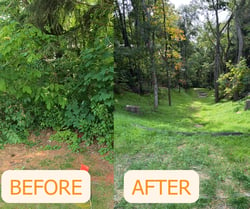 As the subdivision was built beginning in the 1970s, storm sewer systems were routed to discharge directly into the ravines. Over time, concentrated runoff from these storm sewers rushed downhill into the ravines. In one case, an 18-inch corrugated metal pipe discharged into a ravine nearly 375 feet long and dropping more than 45 feet in elevation, causing significant downcutting and erosion. With no downstream protections in place, the energy of that water slowly but relentlessly reshaped the channel—scouring the bed, collapsing banks, and carrying soil away with every storm.
What had once been a stable natural feature became an actively eroding system, threatening both the ravine and the surrounding built environment, including homes, roads, and underground infrastructure.
Porter County officials wanted to stop the damage, restore balance to the landscape, and future-proof the area.
Through the efforts of County officials, Grimmer Construction, and Wessler Engineering, solutions were identified, applied, and constructed that embraced the very terrain that made the site challenging. Rather than forcing water through the ravine as quickly as possible, the team designed and implemented a Step Pool Stormwater Conveyance (SPSC) system—an innovative green infrastructure approach that works with nature instead of against it. Originally developed in similar terrain in Maryland, the system transformed the ravine into a series of gently stepped pools and grade controls, slowing stormwater, reducing erosive forces, and allowing water to infiltrate into the ground. Native vegetation, along with a sand and wood chip bed beneath the channel, now helps store, treat, and safely convey runoff while supporting long-term ecological stability.
The County also had to address the aging drainage infrastructure upstream. More than 875 feet of deteriorating corrugated metal pipe were replaced with new reinforced concrete pipe, along with 15 storm sewer structures, ensuring the entire system functions reliably from collection to discharge.
Completed in the summer and early fall of 2025, the project didn’t just repair a ravine—it reimagined how stormwater could move through a sensitive landscape. Today, water flows through the channel in a controlled, non-erosive way, protecting the moraine’s natural features while preserving the community built around them.
What was once a challenging problem is now a resilient system—designed to last and work in harmony with the land that shaped it.
Tags