This is part 4 in our Arc Flash blog series. Click here to read part 3.
When it comes to electrical safety, knowing your risk is only half the battle. The next step (and one of the most critical) is wearing the right protection for the job. In this post, we’ll explain how to match Arc Flash Personal Protective Equipment (PPE) to the actual hazard levels found on your site, using incident energy analysis as your guide.
Understanding Incident Energy Results
Incident energy is measured in calories per square centimeter (cal/cm²) and represents the amount of thermal energy that could impact a person standing a certain distance from an arc flash event. Your arc flash study should clearly list these values for each piece of equipment assessed.
For the PPE, if you do an incident energy analysis, then you would want to use the incident energy analysis method for selecting the PPE. This will be based on the specific incident energy calculated and shown on the arc flash label and then picking from the ranges as shown in the table 130.5(G) below.
Table 130.5(G) Selection of Arc-Rated Clothing and Other PPE
When the Incident Energy Analysis Method is Used
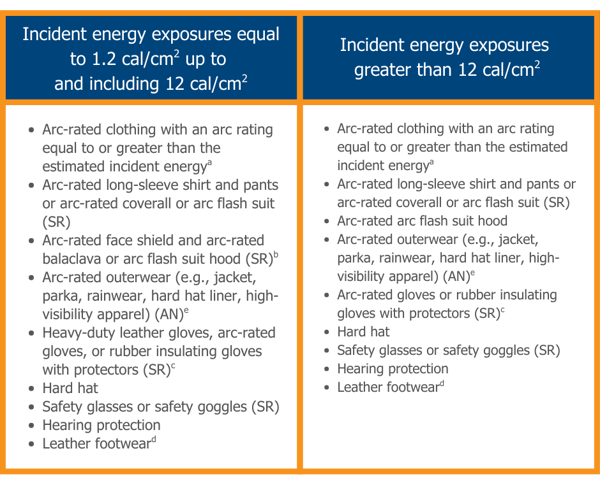
**SR: Selection of one in group is required. AN: As needed. a: Arc ratings can be for a single layer, such as an arc-rated shirt and pants or a coverall, or for an arc flash suit or a multi-layer system if tested as a combination consisting of an arc-rated shirt and pants, coverall, and arc flash suit. b: Face shields with a wrap-around guarding to protect the face, chin, forehead, ears, and neck area are required by 130.7(C)(10)(c). Where the back of the head is inside the arc flash boundary, a balaclava or an arc flash hood shall be required for full head and neck protection. c: Rubber insulating gloves with protectors provide arc flash protection in addition to electric shock protection. Higher class rubber insulating gloves with protectors, due to their increased material thickness, provide increased arc flash protection. d: Footwear other than leather or dielectric shall be permitted to be used provided it has been tested to demonstrate no ignition, melting, or dripping at the estimated incident energy exposure. e: The arc rating of outer layers worn over arc-rated clothing as protection from the elements or for other safety purposes, and that are not used as part of a layered system, shall not be required to be equal to or greater than the estimated incident energy exposure.
Typically I've always recommended to default to the minimum PPE even when the hazard is less than 1.2cal (even though it says it's not required, this is just because it's easier to require for all so there is no confusion and builds good habits of using PPE over time if they are not used to using it prior).
Bottom line on the calculated method is that they are wearing clothing with cal ratings that exceed what is calculated on the label. When more than 40 cal, then reviewing work task table, likelihood/risk factor of the work being performed and equipment condition to determine if wearing PPE above 40 cal would be warranted.
Typically I've seen where standard everday work wear is rated just above the 12 cal threshold and then they have a suit layer over it that carries the higher cal rating to keep things simple.
Selecting the Right PPE
The goal is not to over-armor your team it’s to provide just enough protection without impairing mobility or comfort. Arc flash labels will typically indicate the required PPE level (e.g., CAT 2), or in some cases, list the exact incident energy. That’s where a well-maintained PPE matrix comes in.
A matrix aligns PPE categories with the real-world gear your team needs:
- Arc-rated clothing (shirt, pants, coveralls)
- Insulated gloves with leather protectors
- Arc-rated face shields or hoods
- Balaclavas, hearing protection, and safety glasses
Make sure your PPE matrix is easily accessible, regularly updated, and understood by both field crews and supervisors.
Common Mistakes to Avoid
One of the biggest missteps we see in the field? Using voltage as a shortcut for PPE selection. Just because a piece of equipment is 480V doesn’t mean it presents the same arc flash hazard as another 480V panel down the hall.
Always rely on incident energy results, not voltage ratings to determine the correct PPE. Another frequent issue: workers using PPE that’s worn, damaged, or uninspected, which can undermine the protection level. If you notice stains on the PPE, that can be sign that the PPE needs to be replaced as it might not perform as expected.
PPE Maintenance and Inspection
PPE isn’t “grab-and-go” gear...it requires care. FR clothing should be washed according to manufacturer guidelines and inspected for rips, tears, or signs of wear. Rubber-insulated gloves must be:
- Air-tested before each use
- Visually inspected for cracks or contamination
- Dielectrically tested every 6 months
Helmets, face shields, and arc-rated hoods should be checked for scratches, UV damage, or expired ratings.
Bottom Line
Arc flash labels and studies don’t protect your workers...the right PPE does. And that PPE must be:
- Matched to actual incident energy values
- Selected using a well-designed matrix
- Maintained and inspected regularly
- Understood and used properly by all qualified personnel
This is where safety and engineering come together — and where culture, not just compliance, keeps teams protected.
If you’re unsure whether your PPE program is up to date or if your team needs help interpreting labels and hazard analysis, you can reach me at chrisg@wesslerengineering.com or 317-788-4551.
There is no arc flash problem we can't solve together.
Tags